
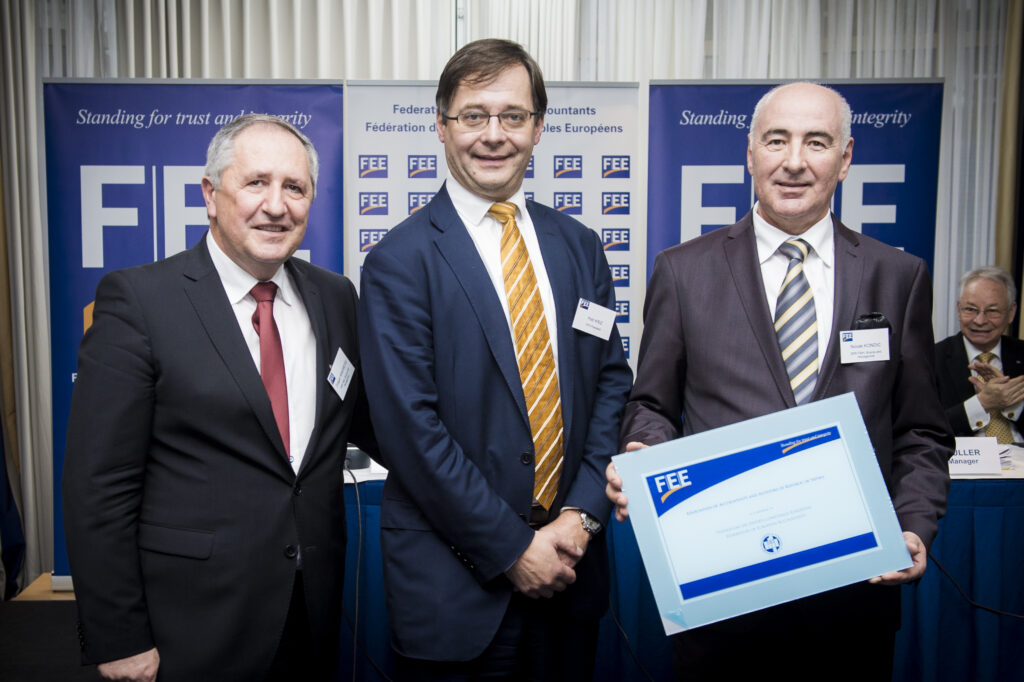
The 16th of December 2015 shall be written in golden letters in the history of the Association of Accountants and Auditors of Republic of Srpska. On this very day in Brussels our Association became a full member of the Federation of European Accountants (FEE – Fédération des Experts comptables Européens). Not only the membership confers a priviledge but it also entails an additional obligation and responsibility for both the management and members of the Association.
Within the ceremonial part of the meeting the Board of the FEE, besides the Association of Srpska, also welcomed the Association of FBiH as its full member and the professional association from Latvia as its associate member.
Before the FEE’s Board meeting a panel discussion was held at which discussed were possibilities of the development of the accounting profession in Europe in light of new proposals of the European Commission.
The Capital markets related introductory theme – improved access to finances for businesses was presented by Niall Bohan, (European Commission, head of a unit of the Capital markets
union)
An Action Plan on Building a Capital Markets Union which was developed for purposes of building a true single market for capital for all 28 member countries was presented. An ultimate objective of the Union, which is also one of the priorities of the European Commission, is to facilitate business operations in Europe particularly with respect to small and medium-sized companies in order to improve their access to funding and connect them with a range of funding sources.
Some of the most important measures under the discussion included:
- Reducing dependence on bank financing
- Improved cross-border connectivity among potential investors and financing
companies, - Removing barriers to cross-border capital movement
The second proposal of the European Commission under discussion was about the new strategy which is aimed at the improvement of a single market for services. The introductory presentation which also included remarks about the related role of the accounting profession was held by Jurgen Tiedje (European Commission, head of unit for Business to Customer Services).
During the presentation it was emphasized that the main objective of the Strategy is to create the new opportunities for professional service providers whereby the European Commission wishes to facilitate cross-border services provision and support new innovative business models. The access to new markets should help small national firms to grow into large European players. The audit services are regulated at the EU level unlike the other accounting services therefore removing barriers with respect to these services may open up new opportunities.
The third topic under the discussion was titled „Barriers to borderless market – corporate tax“, and the mediator was professor Hans van den Hurk (Maastricht University) The companies operating within European Union potentially face 28 different tax regimes.
The European Commission proposes simpler system of computing their taxable income. In the case of CCCTB-Common Consolidated Corporate Tax Base, business entities would deal with only one system the requirements of which they would have to meet and according to which their respective taxable income would be computed. The idea is to create a favourable business environment by reducing administrative barriers, costs to adjusting to different systems and legal uncertainties. Business entities agree in general to this proposal. Both advantages and shortcomings have been underlined theretofore however a question arises as to the potential approach to be taken by the accounting profession with respect to these issues.
- Reserach show that business entities are satisfied with this solution thus the question ensuing is the following: whether the accounting profession should in general support the proposal?
- The European Commission’s plan is to start with introducing a new single corporate tax base and to move to a consolidated version at some future time, to enable member countries to more easily harmonize. A question arising is whether the accounting profession should support this approach?
- Is the European accounting profession of the opinion that such a system should be mandatory?
- What impact would it have on member countries and Europe’s competitiveness in this
respect?